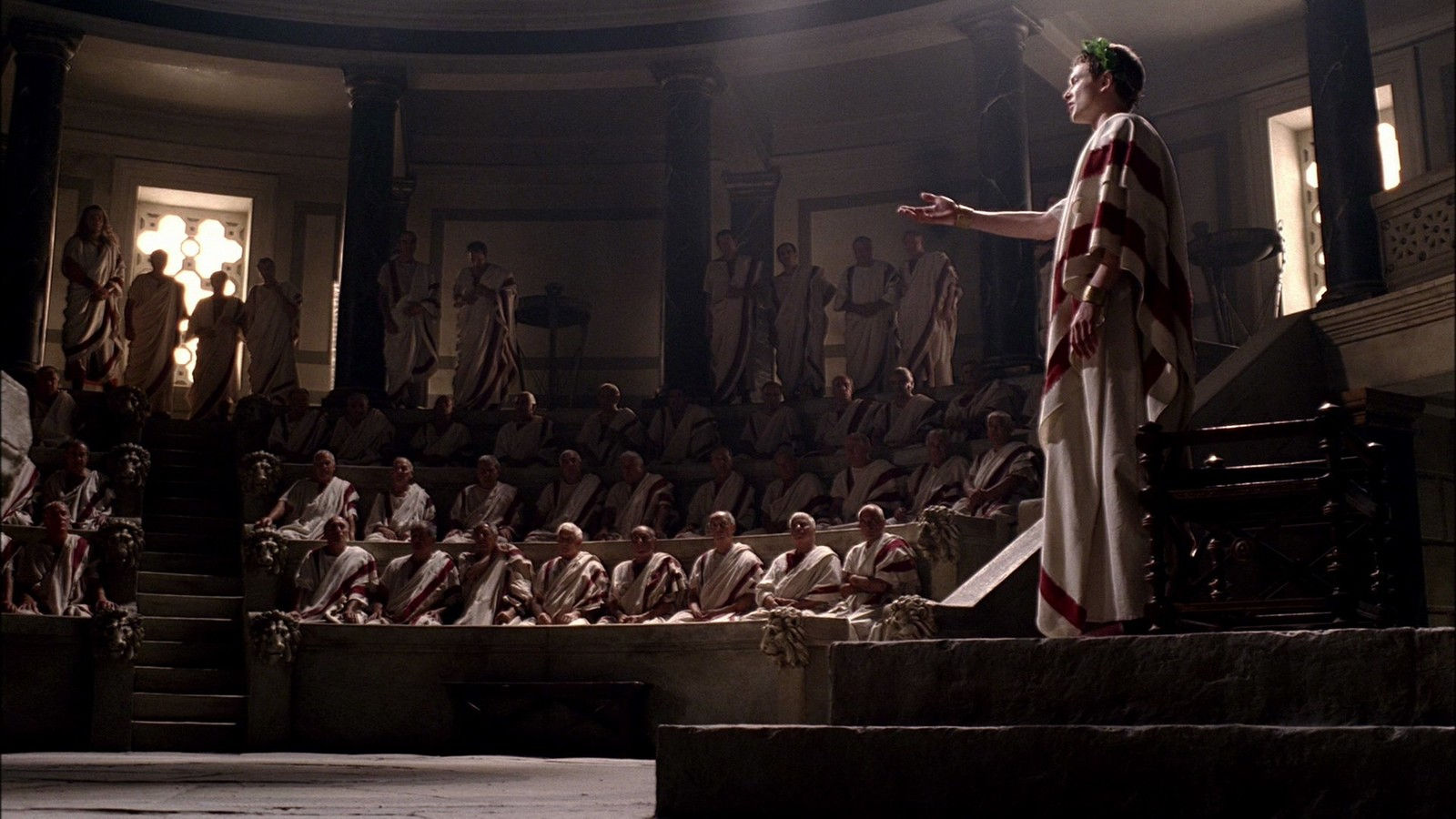

CHAPTER GLIMPSES: HOW A REPUBLIC DIES

The uncle of Julius Caesar by marriage, Gaius Marius is perhaps the most perfect place to begin when investigating the decline of the Roman Republic. Nothing was so ruinous to the sublime experiment that was the Republic of the Romans than this man's personal predilection for glory. Yet this betrayal of the noble Roman love for the Republic did not manifest in one day, his many and various military campaigns eventually accustomed him to adulation and gravitas. This became his downfall and with him that of the Republic also.
In the train of luxury came vice; self-restraint was broken down; the power of self-government was lost; and the Roman republic failed, as every other republic will fail, when that fails by virtue of which alone a republic is possible. The Romans ceased to govern themselves, and they had to be governed. They lost the faculty of self-government, and with that vanished the republic, and its place was supplied by an imperial tyranny supported by a military despotism - A. T. Jones, The Two Republics pg.18
Marius had first served in Spain together with his sidekick Sulla and interestingly enough Jugurtha as well, a prince of Numidia which was a client state of Rome in present day Algeria. In 107BC Marius was elected Consul and set about to reform the Roman military. Since the defeat and destruction of Carthage, Rome had grown enormously wealthy and powerful, she had far flung possessions to protect and a seasonal citizen army would not be sufficient. We have already considered the moral decay of the Republic in the chapters dealing with the Senatorial instigated assassinations of the Gracchi brothers, but now the Marian reforms would endanger the Republic in more structural ways than principles ever would. At this time Rome had been fighting an insurrection in Numidia against now King Jugurtha for five years already. Marius would face off his old comrade but not without a plan.
A STANDING ARMY

With Rome's manpower depleted and insufficient, Marius quickly abolished land and wealth requirements for soldiers in order to make up for numbers. Previously the Romans had extolled what they saw as the virtues of the citizen warrior farmer. A soldier's position of command was determined by his land and wealth requirement which served also as his tax and census bracket. Soldiers paid for their own gear, hence the poorest were skirmishers and the wealthiest, usually senators, could become horsemen or commanders. This meant that Marius had to overhaul the training and command structure as well and that he did, setting up the Contubernium system after which he placed a fifteen year limit on military service. In other words, no longer was this a citizen army that could be called up only in moments of need, but in order to meet very pressing current needs, Marius had turned the Roman army into a standing army.
This was an administrative alteration that would forever change Roman society. Fast forwarding, a standing army was identified by the American founders as one principle danger to the life and health of a Republic, as Alexander Hamilton noted in Federalist paper number 8:
But in a country, where the perpetual menacings of danger oblige the government to be always prepared to repel it, her armies must be numerous enough for instant defence. The continual necessity for his services enhances the importance of the soldier, and proportionably degrades the condition of the citizen. The military state becomes elevated above the civil. The inhabitants of territories often the theatre of war, are unavoidably subjected to frequent infringements on their rights, which serve to weaken their sense of those rights; and by degrees, the people are brought to consider the soldiery not only as their protectors, but as their superiors. - Alexander Hamilton
The fears of Alexander Hamilton were based on what transpired 1800 years prior during the Marian reforms. This new army that Marius took with him to subdue Jugurtha would be called the mules of Marius. Soldiers would grow affection for their commanders. Armies would become loyal to their Generals instead of loyalty to the Senate and People of Rome. And why? Because having abandoned their farms for a fifteen year commission, they were dependent on their Generals for their livelihoods. The emergence of strongmen was not far away, Marius and Sulla were indeed to be the first. Their falling apart and subsequent war would bring to the open that which had already transpired against the Republic in the realm of principles.

Comments